Romantic Realignments is one of the longest-running research seminars in Oxford.

Past speakers have included Marilyn Butler, Gerard Carruthers, David Chandler, Heather Glen, Paul Muldoon, Philip Shaw, Fiona Stafford and Peter Swaab, to name but a few.

All are very welcome to submit an abstract — we aim to provide a friendly 'workshop' setting in which speakers can try out new papers as well as more finished pieces, and in which lively discussion can flourish.

Held on Thursdays at 5.15pm, Seminar Room A, St Cross (English Faculty) Building.

If you would like to send us an abstract or suggest a speaker, please contact the current convenors Katherine Fender, Sarah Goode and Honor Rieley at: romantic.realignments@gmail.com

13/02/2014

Week 4 – 'Hume, Shelley and the Evolution of Myth'

Pablo San Martín Varela, University of Edinburgh


This week sees the second part of our Edinburgh double-header, as Pablo San Martín speaks on the shift from an Enlightenment to a Romantic definition of 'myth'.

Abstract:

This paper explores the history of the modern conception of ‘myth’ as it emerged during the Enlightenment, and how it was then reshaped during the Romantic period, centring on the works of David Hume and Percy Shelley. In An Enquiry Concerning Human Understanding and The Natural History of Religion Hume developed the basic enlightened conception of myth as ‘fable,’ ‘invention,’ ‘fiction,’ or ‘illusion’, which according to the philosopher of religion Mircea Eliade later prevailed during the nineteenth century and is still present today’s use of the word ‘myth’. In the aforementioned works, Hume assessed myths in terms of an empiricist criterion of truth, and regarded them as corrupted historical records which had lost all relation to the original facts they were supposed to refer to. Shelley inherits this enlightened conception of myth from Hume, and deploys it in his early critique of religion (letters, prose and poems), levelling the narrations contained in the Bible with pagan mythology. In his later poetical practice, however, (especially in Prometheus Unboud and Hellas, and their prefaces) Shelley advanced a different and more positive conception of myth (which we could call ‘Romantic’) as  ‘true story’, ‘sacred tradition’, ‘primordial revelation’, and ‘exemplary model’, together with a more idealistic criterion of truth.

All welcome as always!

05/02/2014

Week 3 – 'The Antiquarian Collections and Fictions of Horace Walpole and Walter Scott'

Lucy Linforth, University of Edinburgh


We're very happy to have Lucy Linforth with us this week, all the way from Edinburgh! She's going to be speaking about antiquarian objects and the important role they play in the writings of Scott and Walpole.

Abstract

This paper explores the antiquarian collections held by Walpole and Scott at Strawberry Hill and Abbotsford House respectively, examining their historical and material significance upon the works of both authors. My paper will explore how the object of and objects in these collections might find resonance and representation within the pages of Walpole and Scott’s fictional works.
     In my discussion of Walpole, I will follow the recent example of scholar James Lilley, who has suggested that the collection at Strawberry Hill offers an insight into Walpole’s philosophy of both antiquarianism (‘uniquity’), and of the eighteenth-century narrative of history. Furthermore, I would also suggest that the significance of the antiquarian object in Walpole’s novel The Castle of Otranto (1764) has hitherto been underestimated, and therefore I begin to explore this importance in my paper. Turning to Scott’s fiction, I would suggest that several of his fictional works spring directly from items he collected and displayed at Abbotsford; I hope to demonstrate this using examples from the Abbotsford collection. I will also suggest that Scott too, like Walpole before him, laid great significance upon the presence of the antiquarian object in his fictions, which even acts occasionally as narrative agent.  

27/01/2014

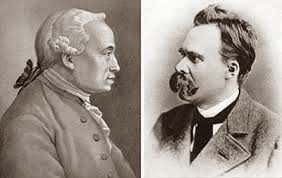
Week 2 - "Metaphysics as Aesthetics: On Nietzsche’s Critique of Kant’s Teleology"

Nicolas Lema (Somerville College, University of Oxford)


This week, we're delighted to be welcoming Nicolas Lema from the University's Faculty of Philosophy; he'll be speaking to us about Nietzsche's response to Kant's notion of teleology:


Abstract

In 1868, Nietzsche planned to write a dissertation on Kant’s Critique of Judgment (1790) specifically focusing on Kant’s concept of teleology. Nietzsche, however, abandoned the project and left us with a set of notes entitled “On Teleology.” These complex series of notes reinterpret and radicalize some of Kant’s most cherished concepts used in the Third Critique to study both art and biology. Here I will focus on Nietzsche’s critique and radicalization of Kant’s notions of regulative principle and reflective judgment. For Kant, reflective principles of judgment guide our cognition about particulars in nature in the form of a subjective rule; not as an ontological claim about nature. For scientific purposes, however, a principle of natural teleology—a principle that claims things in nature happen for the sake of something—must be presupposed in order to guide research. This principle acts as a ‘regulative maxim’ that guides experience. I will argue that Nietzsche’s notes point to the essential ‘aesthetic’ content, not only of regulative principles, but also of the whole realm of metaphysics. Teleology becomes nothing but an “aesthetic product,” as Nietzsche puts it. This will lead Nietzsche to an implicit critique of Kant’s harmonic view of reason as architecture.

As ever, all are most welcome to attend both the seminar and the wine reception - we look forward to seeing you then!

21/01/2014

Week 1 – 'Wordsworth After Bathos'

Robert Stagg, University of Southampton


Our speaker for this first Romantic Realignments of Hilary Term proper is Robert Stagg, who will respond to the characterisation of Wordsworth as 'a writer of "good Bad Verse" (Wyndham Lewis)' with a paper that aims to 'defend Wordsworth’s bathos':

This defence cleaves into two categories, even as those two categories ultimately cleave to each other – noticing 1) the ability of bathos to clear false wonder from verse, mocking and twitting it, before revealing a true wonder; and 2) the way in which bathos can hold a latent energy of wonder, so that Wordsworth can extract a “hyperclimax” (in Coleridge’s terminology) from an anti-climax. My paper will begin by considering the nature of bathos, with brief examples from Pope, Byron, Clough and others before turning to the specifically Wordsworthian bathos outlined in points 1) and 2) above. I will examine Wordsworth’s paratextual writings about bathos, in the ‘Preface’ to the Lyrical Ballads and the notes to some of the poems, while turning to the poems themselves. I will consider some of Wordsworth’s late poetry and the Alps episode in Book 6 of The Prelude as examples of bathos 1) before turning to ‘Simon Lee’ as an example of bathos 2). My paper will conclude by examining the role of bathos in the relationship between Wordsworth and Coleridge. I read ‘The Thorn’ as a bathetic collapsing of The Ancient Mariner. I then think about ‘The Idiot Boy’ as a sequel to ‘The Thorn’, for which there is much manuscript evidence, in which ‘The Idiot Boy’ becomes the wondrous poem sprung from its bathetic predecessor. “Exalted by an underpresence” (The 1805 Prelude, 13.71), Wordsworth’s poetry finds wonder in slumps, stumbles, shrinkages, even snails. It is a wonder emitted not through a Coleridgean (as Wordsworth sees it) solemnity but through the comic manoeuvres of bathos – something my paper will explore, chart and advocate.

As always, all are welcome at our usual time of 5.15!

14/01/2014

Week 0 - "Counterfactual Romanticism"

Professor Damian Walford Davies
 (Cardiff University)


A very Happy New Year to all! As a special Week 0 seminar* to kick off our 2014 programme, we're very pleased to be welcoming Professor Damian Walford Davies, who will be speaking on notions of "Counterfactual Romanticism" in relation to one of his current projects:

Abstract

Historicism (of various modalities) remains the critical and methodological orthodoxy in Romantic Studies. It’s had a good innings. Dare we imagine ways beyond it and cultivate more radical rhetorical moves in our attempts to get away from, and then back into, the literary text’s various ‘histories’ (and the ‘histories’ of our own criticism)? How might a counterfactual move refocus the ways we configure the literary ‘past’? This paper, which offers an account of the genesis, current contours and potential afterlives of the project Counterfactual Romanticism, tendentiously opens a window on how things might be – for ourselves as critical latecomers and for the Romantics, too – ‘otherwise’.

Join us for what promises to be a compelling talk to see in the new term - all are welcome to attend as ever, and we hope to see you on Thursday!  

*Please note the slightly earlier time of 5:00pm for this week's seminar.

13/01/2014

Hilary 2014 Termcard

Romantic Realignments


Thursdays at 5.15, English Faculty Building, Seminar Room A.
* Extra seminar in Week 0 this term.


* Week 0, 16 Jan, 5pm (note earlier time!):
Damian Walford Davies, Cardiff University
Counterfactual Romanticism

Week 1, 23 Jan:
Robert Stagg, University of Southampton
Wordsworth After Bathos

Week 2, 30 Jan:
Nicolas Lema Habash, Somerville College, Oxford
Metaphysics as Aesthetics: On Nietzsche’s Critique of Kant’s Teleology

Week 3, 6 Feb:
Lucy Linforth, University of Edinburgh
The Antiquarian Collections and Fictions of Horace Walpole and Walter Scott

Week 4, 13 Feb:
Pablo San Martin Varela, University of Edinburgh
Hume, Shelley and the Evolution of Myth

Week 5, 20 Feb:
Edward Larrissy, Queen’s University Belfast
Future Romanticisms

Week 6, 27 Feb:
Christoph Bode, Ludwig-Maximilians-Universität München
De-frosting the Discourse on the Subject: S. T. Coleridge

Week 7, 6 March:
Anna Mercer, University of York
Creative Tension: how did Percy Bysshe Shelley and Mary Wollstonecraft Shelley collaborate after Frankenstein?

* Week 8, 10 March (Monday):
Bruce Graver, Providence College
America through a British Lens: William England’s Stereoscopic Tour

03/12/2013

Week 8 – 'Rationality, Religion and Female Dissent: Elizabeth Heyrick'


Rebecca Shuttleworth (University of Leicester)


For the final Romantic Realignments of 2013, we're very happy to have Rebecca Shuttleworth with us to share some of her research on dissenting women writers. 

Abstract

The abolitionist campaigner Elizabeth Heyrick (1769-1831), was born into a dissenting family in Leicester, but asserted her independence later in life by leaving the Methodist Church to join the Society of Friends. Previous accounts of her life have often assumed that her social activism was very much a development of her new Quaker environment. This paper will suggest that the picture is more complicated than that, and will explore the complex interplay between the values of rationality, social morality, and religion in her life and writings. It will draw on family and friends’ writings about Heyrick, as well as her own numerous pamphlets, to explore the ways in which a radical female activist emerged from within a Midlands dissenting community. Heyrick’s voice, as it emerges in her writings, both works within, and against, the social expectations of her surrounding community and culture. In her appeals to rationality, rather than religion, in her justification of her various crusades, she emerges strongly as a voice of Enlightenment values. The paper will explore the dissenting community of Leicester at that period, the various role models available to Elizabeth, and the ways in which she constructed her own voice. It will consider her abolitionist writings, as well as her associated campaigns against animal cruelty, and her call for a total boycott of sugar and all products produced by slave labour. Heyrick’s understanding of social responsibility and moral identity remain remarkably consistent through her life, and must be understood not just in terms of her religion, but the wider Enlightenment commitment to the values of rationality.

All are welcome – please come along and help us round off Michaelmas term in style!